
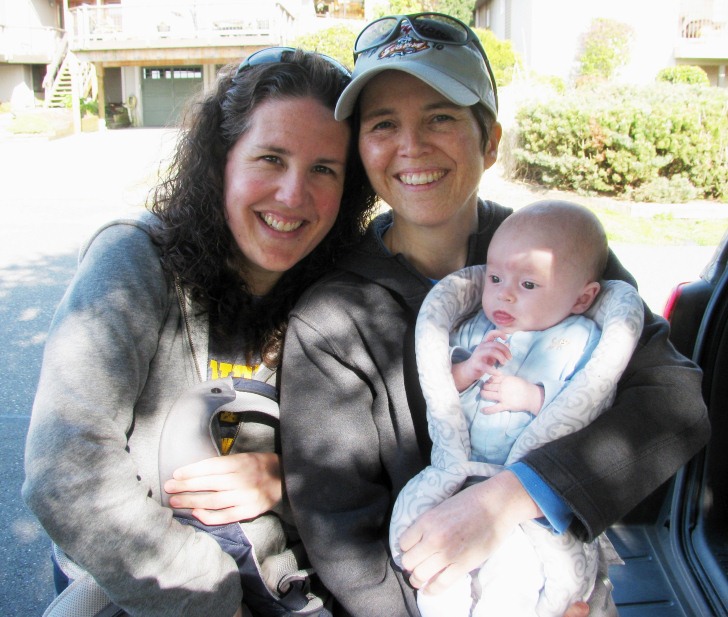
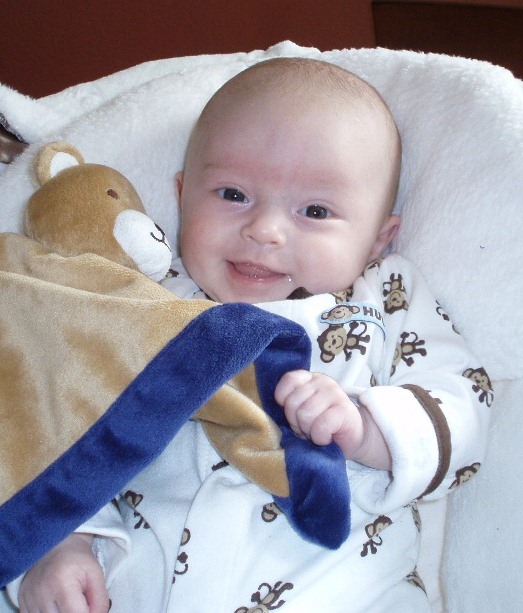
 This week, gay marriage has been back in national news as the New York state legislature debates passage of a bill legalizing same-sex unions. For Kris and me, it’s been on our minds, too–on Saturday we’ll celebrate the sixth anniversary of our legal Massachusetts marriage. Generously, friends have agreed to babysit our daughter while Kris and I go out on our first real date since Alex’s birth four months ago. While we adore Alex, we’re both looking forward to a leisurely, non-microwaved dinner where we don’t have to take turns eating while the other mom amuses the baby.
This morning, while reading Advocate.com, I wasn’t particularly surprised to learn that a former NFL player had come out publicly against the gay marriage bill in NY. However, the irony inherent in former NY Giants wide receiver David Tyree’s comments caught my attention, along with that of hundreds of other bloggers and media outlets. In a video recorded for the anti-gay group NOM, Tyree announces, “If they pass this gay marriage bill… what I know will happen if this does come forth is this will be the beginning of our country sliding toward, you know, it’s a strong word, but anarchy.”
Now, I hate to do the Freshman Composition move here and offer up a dictionary definition, but I feel I have no choice. So here goes:
Anarchy: A state of lawlessness or political disorder due to the absence of governmental authority; absence or denial of any authority or established order. (The Free Merriam-Webster Dictionary)
State of lawlessness–wait, why does that sound familiar right now? Oh, yeah, because I live not far from Vancouver, B.C., where hockey fans last night rioted when their beloved Canucks lost game 7 of the Stanley Cup finals. Canadians took to the streets and overturned cars, set fire to other people’s property, and participated in drunken brawls, injuring more than 150 people in downtown Vancouver, lauded for its successful stint last year as W inter Olympics host. Images from the night’s exceedingly unsportsmanlike conduct show Canadian police in riot gear (no horses in sight, fortunately) firing tear gas and rubber bullets into crowds silhouetted against burning cars. WTF, Canada? As Kris quipped, good thing our neighbors to the north don’t carry guns.
Of course, it isn’t the first time that anarchy has descended on a North American city following a sporting event. Helpfully, Time.com has provided a guide to the ten most shocking sports riots of all time: When Fans (and Players) Get Violent. L.A. has developed something of an NBA riot tradition–since 2000, Lakers fans have taken to the streets on three separate occasions to destroy property and beat people into submission. But it isn’t only fans doing the brawling, the Time.com article points out. Athletes themselves have been known to ignore rules and laws in their haste to throw down.
Former NFL player Tyree, a self-proclaimed reformed alcoholic and born-again Christian who turned to God after being arrested in 2004 for illegal drug possession (a clear transgression against governmental authority), grounds many of his arguments against gay marriage in his religious faith. In the NOM video, Mr. Tyree continues his inadvertant sliding toward irony with the proclamation that straight marriage is “holy and sacred.” He goes on to explain, “There’s nothing more sacred than fighting for it, you know, especially if we really care about our future generations.”
Why do I find it ironic that a football player would make such a pronouncement, you ask? Or perhaps you’ve already made the same leap I have. Whenever I think of “professional male athletes” and “marriage” in the same sentence, I picture Tiger Woods and his sad sex-addiction press conferences; Kobe Bryant and the ginormous ring he gave his wife a few days after being charged with sexual assault; or the Love Boat Scandal featuring more than a dozen members of the Minnesota Vikings who flew prostitutes in from other cities for a sex party on a chartered lake cruise. Clearly, all of these professional athletes view their marriages as both sacred and holy, and care a lot about their future sexual–I mean, our future generations. (For a satirical piece that sums up beautifully the cheatingness of male sports stars, check out thebrushback.com’s Kobe Bryant To Resume Cheating On His Wife. Priceless.)
Another blogger commented that Tyree “says a bunch of stupid shit” in his NOM interview, and I have to agree. For example, when asked what message gay marriage sends, Tyree replies, “That you don’t need a mother or a father… Two men will never be able to show a woman how to be a woman.”
 Huh. And here I was thinking that the message my gay marriage would someday send to our daughter was that her two moms love each other enough to stand up in front of a gathering of supportive friends and family and announce that we intend to face together the good times and the bad, that we pick each other over all others. I thought Kris and I chose to get married for the same reasons that others before and after us have done so—love, family, commitment, a desire to make our relationship as permanent as we can in a culture of impermanence. According to Tyree, I got it all wrong.
But as far as I know, our wedding day six years ago didn’t cause anyone to take to the streets looting and pillaging, burning cars or homes, beating and even in some cases raping their way across urban landscapes. I’m pretty sure that no one outside our circle of friends and family even knew we’d gotten married, except for the Commonwealth of Masschusetts, which granted our marriage license. Unlike the violence in Vancouver last night or the 1994 riots in Detroit after the Tigers won the World Series, our same-sex marriage has resulted in no deaths, no injuries, no destruction, only in the birth of a beautiful, sweet baby girl who we somehow manage to love more and more every single day.
But there is good news in all of the hubbub over Tyree’s anti-gay religious ramblings. Tyree, it turns out, launched his NOM attack in response to a video that former NY Giants defensive end Michael Strahan and his fiancee Nicole Murphy filmed for HRC’s NYers for Marriage Equality campaign:
I gotta say, it’s nice to see a former NFL player and current commentator for FOX Sports talking about his gay friends and his belief that they have the right to marry whomever they choose, just as he does. When asked if he was concerned about repercussions for publicly supporting gay marriage, specifically in his work as an NFL commentator, Strahan apparently noted that FOX is, after all, the network that airs “Glee.”
Still, I can’t resist pointing out one last bit of irony lurking in Tyree’s comments. Gay marriage is, in point of fact, the opposite of anarchy. As I’ve noted elsewhere, legal marriage in the United States is a civil act that requires a license from the state. By applying for a marriage license, both parties, gay or straight, are applying for government recognition of and involvement in their personal relationship. Far from being a nod to anarchy, getting married is an example of willingly submitting oneself to governmental authority. Folks like Tyree who are against gays getting married are the real anarchists in sheep’s clothing. In their haste to exclude gays and lesbians from the accepted social order, NOMers and their friends would prefer our same-sex relationships continue to exist in a state of legal limbo, unrecognized and unacknowledged by the state to which we pay taxes and in which we otherwise participate as fully legal citizens.
Given that Kris and I have a valid, binding marriage certificate from Massachusetts, and that our government is founded on the separation of church and state, I can’t say I find David Tyree’s arguments for why we should be denied our civil marriage rights very compelling. I only wish more people could say the same. A glance at the comments on YouTube under Strahan’s supportive video reveals that the 47% minority of Americans who currently oppose gay marriage may be the same sort of people who riot when their teams lose a championship game. Or even when they win.




















 Homodramatica
Unsettled in Seattle
I’ve been a fan of the NPR program This American Life for years. I subscribe to the podcasts on iTunes and donate money to the show when I can afford the ten bucks. I used to be a professional dog walker, and could regularly be found strolling through local parks appearing to talk to myself and/or giggle for no reason, iPod buds in my ears transmitting the latest TAL episode.
That’s why I was so surprised and disappointed to hear Jeanne Darst’s choice of wording during Act Three of “#439: A House Divided,” originally broadcast on June 24. I was at the copy machine at work listening to the show–hooting aloud throughout Jullian McCullough’s hilarious Act Two about his un-hilarious burst appendix–when Darst’s story about her divorced parents started. She hadn’t gotten very far when she used a phrase that made me pause the podcast, rewind, and check to confirm that I wasn’t hearing things. Sure enough, here’s what Darst said: “[T]he women’s clothes were the most outdated, buttoned-up, queer [bleep] imaginable.”
Now, I’m not writing this response out of any supposed sense of “political correctness,” but rather as a lesbian writer who genuinely believes in the importance of language. The increased media and community attention recently afforded incidences of suicide among queer, bullied youth has been commendable. However, queer kids have been driven to kill themselves for at least as long as their classmates have been joyously and vociferously participating in games of “Smear the Queer,” and probably just as long as their teachers have looked the other way when it comes to straight-on-gay verbal and physical attacks. Language is one tool among many still wielded by our anti-gay culture, and may appear from the outside to be the most innocuous form of homophobia. But as a lifelong lesbian—my second grade teacher outed me to my parents, according to my mother, and not in a good way—I can personally attest to the sneaky, lingering power of homophobic insults, particularly on the sensitive among us.
Episode #439 leaves me questioning my allegiance to TAL—or rather, to be precise, TAL’s allegiance to queer folks. Was Darst’s problematic usage of the word “queer” questioned by the show’s producers? Was there a specific decision to allow the story to run as is, or did the issue not even cross TAL’s radar? And is Darst actually unaware that using the word “queer” in a negative sense promotes a derogatory attitude toward GLBT people, or does she simply not give a [bleep]?
Until now, I’ve always believed that TAL’s producers cared about language and social justice as much as I do. But unlike the average kid on the playground, the producers and contributing writers at TAL very much know better than to equate gay with stupid and queer with ugly. Or they should, anyway.