Update: As planned, I re-published The VSED Handbook through a distributor that utilizes Ingram’s network. As of right now (late on January 21, 2026), the paperback is available on Barnes & Noble, which will ship it to your home or to the store nearest to you for pickup. Your local independent bookstore should be able to order a copy through Ingram as well; the new ISBN is 979-8994556900.
If youneed an ebook copy that works on a Kindle e-reader, I’d suggest buying an EPUB version on Smashwords and then sending it to your Kindle. (I purposely make my books DRM-free so they can be easily shared across platforms.) Directions on how to sync a non-Amazon ebook to your Kindle devices using email can be found here on YouTube. Some people use the Kindle app on their phone or tablet, but email delivery has always worked well for me and only takes a couple of minutes. This method is also useful if you like to read fan fiction or your own writing on your e-reader, or if you like to read free ebooks from Project Gutenberg. That site has a huge collection of public domain classics, among others; if you haven’t checked it out before, I suggest doing so now. Definitely one of my favorite rabbit holes on the Internet.
But I digress. Back to my banned book: As I mentioned in the last post, the publishing site I pivoted to–Draft2Digital (D2D)–uses IngramSpark’s print-on-demand (POD) services and distribution for its print book offerings, which means that not only is The VSED Handbook now available on Barnes & Noble, but preliminary searches indicate that the paperback (which used to ONLY be available on Amazon), is starting to show up on other book sites. I’ll update the book page as this development evolves.
Where to Buy The VSED Handbook in Paperback
To summarize, if you’re looking for a paperback copy of The VSED Handbook, you should be able to find it at these locations:
Hi friends. I know, it’s been a while. Like, a loooong while. Since the publication of my last blog post, my father became very ill from Lewy Body dementia, declined quickly, and went on Hospice. Lewy Body is an awful affliction, even worse than Alzheimer’s in our family’s experience, and he was very ill when he died in the fall of 2024.
Being an adult orphan after helping see both parents through dementia is a whole, entire thing, and I have definitely been on quite the grief journey. I had little interest in writing fiction or even blog posts for many months, and I busied myself with house projects and spending time with my family, all while wondering, “What next?” But recently, I’ve been sensing the old writing vibes stirring. I have notes on two new projects, and I’m actively researching one. I don’t think it’ll be long before I have sample chapters to share with my Patreon folks.
Alas, that’s not why I’m writing. This blog post is to explain why my book about my mother’s end-of-life journey, The VSED Handbook, has gone missing suddenly from Amazon, the only vendor I’d sourced for the paperback version. Ebook copies are still available through Apple Books, Barnes & Noble, Smashwords, and elsewhere, but of course, Amazon is the biggest bookstore in the world, so that’s where I get most sales, for better or for worse.
Over this past weekend (January 11, 2026), I received an automated email from Amazon KDP explaining that my book, The VSED Handbook, had been removed from publication due to violation of Amazon KDP’s content guidelines. In the days that followed, I requested more details a handful of times. Finally, I received confirmation that the book was blocked from further sale and its product description page–along with all of its ratings and reviews–had been wiped from the site due to its “subject matter” providing a “poor customer experience.” After four years on sale, the book had somehow triggered a quality review that determined VSED is a violation of KDP guidelines, despite the fact it is a legal end-of-life option specifically for terminally and seriously ill people, not for the general public.
It’s not just my book, either. I know of at least four other titles that share information or personal stories about VSED that have been banned from Amazon’s catalog as well. In discussions with these other authors, we have agreed that it is likely the result of an AI bot/algorithm programmed to exercise heightened sensitivity around suicide after the recent uproar over AI encouraging users to end their lives. That doesn’t make it right, of course, and we’re all still disappointed that something like this could happen. Unsurprised, but disappointed.
I’ve tried to reach a human at Amazon to resolve the issue every day this week, to no avail. But today, after multiple points of contact, I finally received an email that might actually have been authored by a human, indicating that they were researching my request for an appeal and to allow five business days for an update.
UPDATE JANUARY 22, 2026: Amazon rejected my appeals and is refusing to sell the KDP Amazon version of the book in ebook or paperback, based on the “objectionable” nature of its subject matter. Grrrrr. Please buy the book elsewhere if you can. Barnes & Noble carries both digital and print versions.
In the meantime, I am producing another paperback version through my account at Draft2Digital. It’ll be the same book with a different ISBN, and since D2D uses IngramSpark’s print-on-demand (POD) services and distribution for its print book offerings, the end result (I hope) should be that The VSED Handbook is available from even more distributors, not fewer–including independent bookstores and libraries.
So, just in time for the end of Pride month, I published Emma: The Nature of a Lady, my new queer retelling of the Austen classic. Here’s the blurb:
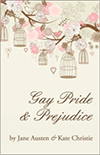
In book one of the Queering the Canon series (Gay Pride & Prejudice), Kate Christie posed a question: What if some among Jane Austen’s characters preferred the company of their own sex? In this new, faithful retelling of Emma, one of Austen’s most entertaining novels, Christie’s question once again applies. Only this time, her rainbow-hued pen revises the characters–and storylines–of Emma Woodhouse, Mr. Knightley, and certain other residents of Highbury.
As Austen herself wrote, “Seldom, very seldom, does complete truth belong to any human disclosure; seldom can it happen that something is not a little disguised or a little mistaken.” This was particularly true for queer characters and themes in Austen’s time. Fortunately, in the 21st century, LQBTQ+ storylines no longer have to hide in plain sight, as they were forced to do throughout Western history.
Christie’s Queering the Canon series advances the proposition that everyone deserves a happy ending–or, at least, to be included in the Western literary canon.
You can find it on Goodreads, Amazon, and Smashwords for now. The paperback and other eBook publishers will follow in mid- to late-July. Reply or send me a note if you want to be apprised of those additional purchase options.
That’s right–I’m finally getting to my Queering the Canon project. As I mentioned some time ago, in the many years since releasing Gay Pride & Prejudice, I’ve often contemplated turning my gay eye on other Western Classics. First on my list has always been Jane Austen’s Emma, due to the homoerotic subtext that’s so obvious that more than one straight white male critic in the 20th century noticed. Feminists in general and lesbian feminists in particular have long celebrated Austen’s exploration of female friendship, and Emma offers so many different meditations on female friendship that shaping a queer variation requires very little work indeed.
Sapphists in Austen’s time
As I wrote on Patreon recently, I’ve received a fair amount of negative reaction to Gay Pride & Prejudice over the years, specifically regarding my choice to edit Austen’s original text to make it gay rather than penning an original variation from scratch. I understand the criticism, but I’ve chosen this approach because I want queer classics, not just queer novels. A few reviews on Goodreads called my approach “lazy” for “switching the words around and nothing else,” which is actually a backhanded compliment–I added 10,000+ new words to the original text of P&P, and apparently these reviewers couldn’t tell the difference between Austen’s writing and mine, heheh. All kidding aside, they are welcome to their opinion. I still want a queer Austen novel, not a Kate-Christie-writing-a-queer-variation-on-Austen novel, so that’s still my approach here as well. Thank goodness Miss Austen’s works are in the public domain.
That said, I am making more changes to her wonderful text this time around. In a Patreon post titled “Queering the Canon: The (Un)likability of Emma,” I wrote at length about my writing conundrum with Emma–how Austen deliberately wrote her titular character as unlikable, and how I’d rather have a version of Emma who is less spoiled and more empathetic, given the dearth of queer classics that feature a positive storyline. (I’m looking at you, The Picture of Dorian Gray and The Well of Loneliness.) No doubt that will annoy more readers, in which case they are welcome to write the book they’d like to read, just as I’m doing.
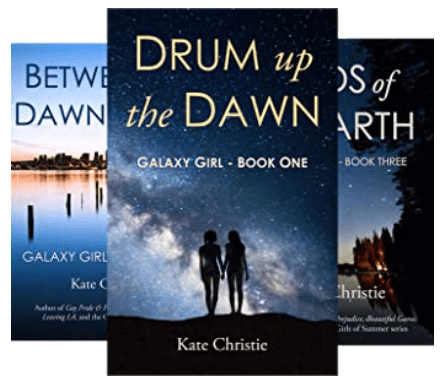
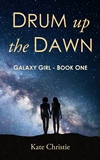
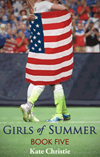
I had intended to revise Emma several years ago, after I finished the fifth book of Girls of Summer, in fact. But then my mother decided she was ready to die, and the pandemic started within weeks of her passing, and all of my careful plans spun out of control. Instead of a sapphic variation on Emma, I wrote a different form of fan fiction, borrowing elements of Supergirl to create my take on an all-powerful, basically immortal (and immune to all forms of disease) lesbian superhero from another planet, AKA Galaxy Girl. I also wrote book six of Girls of Summer; The VSED Handbook, a mash-up between a practical guide to voluntarily stopping eating and drinking and a memoir of my mother’s choice to VSED rather than die slowly from dementia; and (most recently) a fluffy holiday short, ‘Tis the Off-Season: Book 6.5 of Girls of Summer. Grief took me in different directions than I’d planned, but while I might not have been actively working on Queering the Canon, the project was still there at the back of my mind.
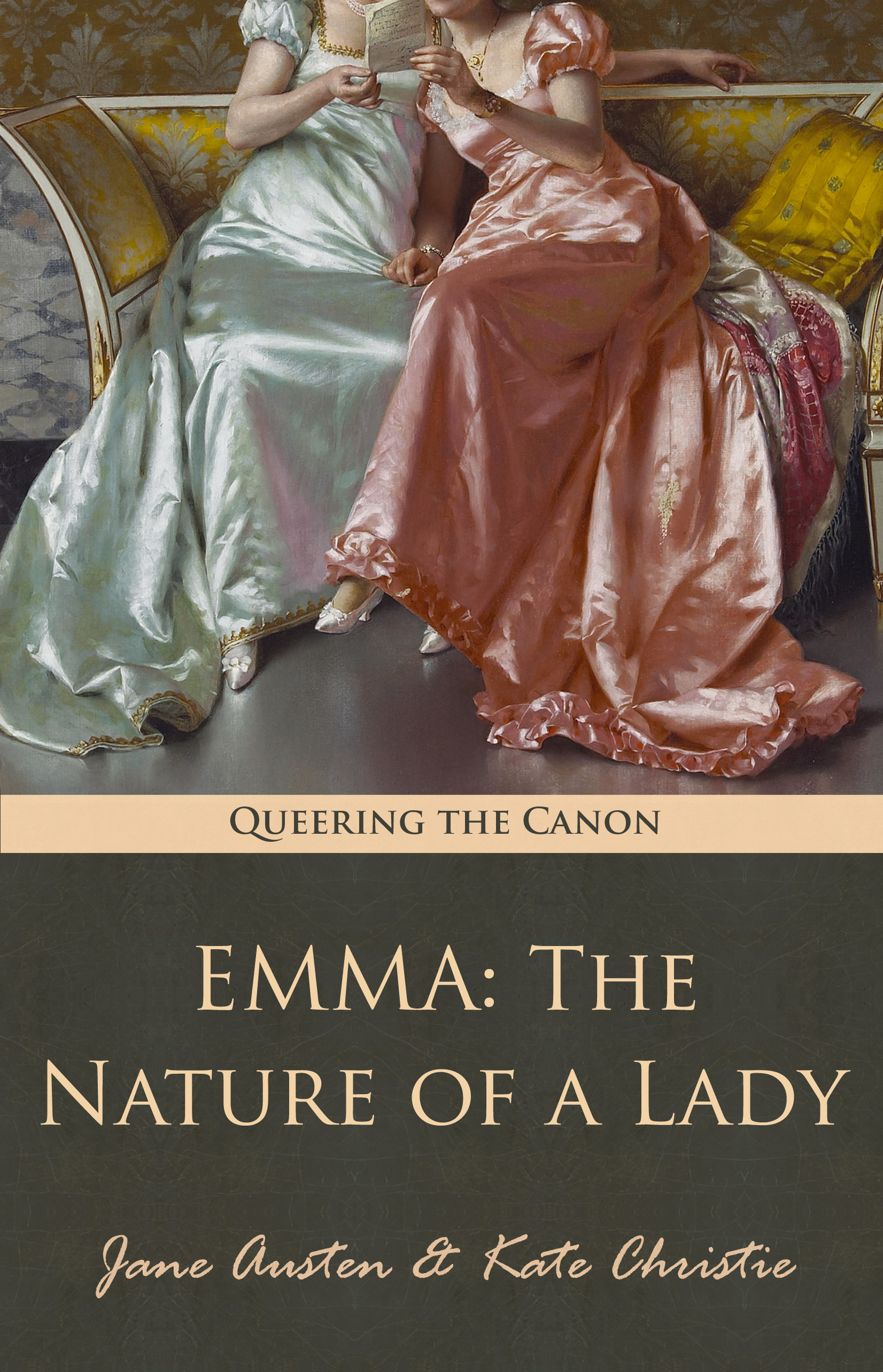
Now, finally, it’s at the forefront of my mind and list of projects. Below is the cover for my upcoming variation, titled Emma: The Nature of a Lady. While I don’t have an exact release date, it should be out in the next couple of months, barring any scheduling changes.
Back in Austen’s England, the categories “heterosexual” and “homosexual” didn’t exist. Instead, pejorative nicknames like “Tommy” and “Molly” were tossed about, and euphemisms about a person’s “nature” abounded. Queer people still existed and acted on their same-sex desires, as Anne Lister and others have proven without a doubt, but in a culture where even a hint of heterosexual impropriety could ruin a gentleman or lady’s reputation, illegal gay acts were punishable by death. Much easier to go along with the status quo than to risk ruin, imprisonment, and even death by revealing your true nature.
That’s why I’ve taken it upon myself to write queer people into historical literary classics. British culture in Austen’s time was so virulently anti-LGBTQ+ that mainstream writers who wanted to sell their books couldn’t even think about penning tales of “unnatural perversion,” let alone stories that featured happy queer people. Actually, even when I was starting out as a writer in the 1990s, nearly two hundred years after Jane Austen began publishing her work, the general consensus was that you didn’t write about queer people if you wanted to sell books. Which, fine. But at this point, I’ve sold more than 40,000 copies of my queer books–including 3,200 copies of Gay Pride & Prejudice–so apparently someone wants to read them.
That’s not why I write, though. I mean, selling books is part of the business, but it’s not a motivating factor for me. I write because I enjoy it and because I would probably, most definitely go a little crazy if I didn’t. If my books find readers who are entertained, I’m happy. If they touch people’s hearts or give them a mental break from the craziness of our current world, even better. Either way, I’ll keep writing, and I’ll keep choosing to write about queer people because doing so is still a political act, even now.
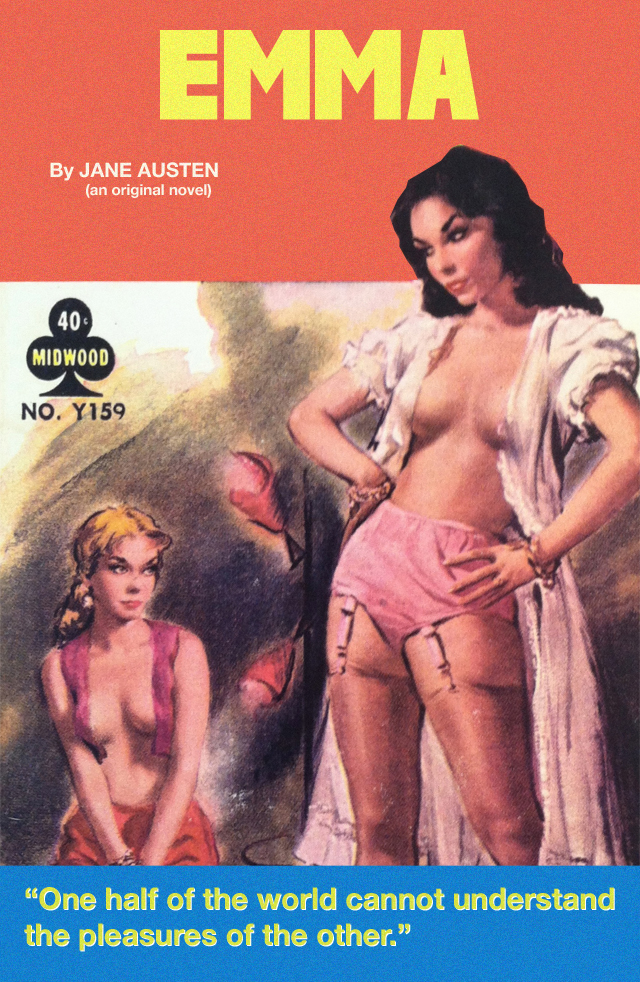
But let’s end on a lighter note, shall we? I know our dear avoidant Emma would certainly prefer that be the case. Speaking of queer Austen takes, Autostraddle, one of my favorite media sites, once reimagined Austen books through a sapphic lens with covers modeled after lesbian pulp fiction books of the 1950s. The hilarious post Every Jane Austen Novel If They Were Gay and Also Historically Inaccurate is accompanied by brief textual descriptions that are absolutely worth reading, especially Mansfield Park in which “[i]nsufferable uptight raw vegan Fanny Price has been raised by her rich aunt and uncle, because her immediate family is poor and does not have the money for the Vitamix and fruit dehydrator she requires.”
At least I’m not making Emma vegan and gluten-free–although I don’t doubt that her father, the narcissistic Mr. Woodhouse, would cut gluten, soy, and other evils from his diet if he were alive now. Still, Emma: The Nature of a Lady takes place in Austen’s time, so Mr. Woodhouse will simply have to suffer through his glutenous cakes and gruel. More’s the pity, according to him.
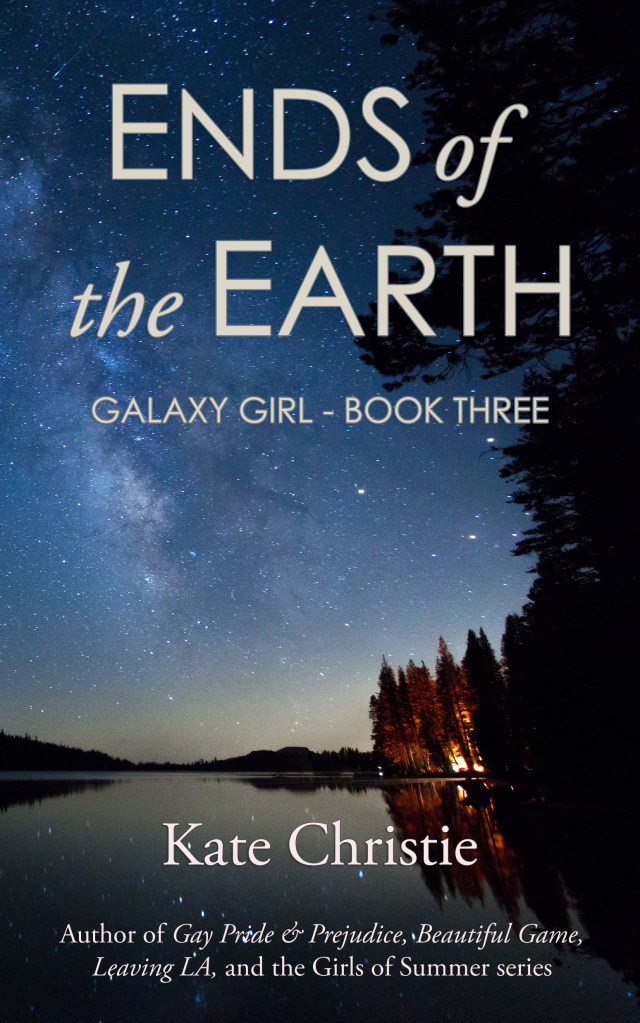
Hi all. I’m back again with a new book. That’s three new releases in six months–whew…
Ends of the Earth is the third and final book of the Galaxy Girl trilogy, my F/F urban fantasy series inspired by Supergirl and, in particular, SuperCorp. If you get a chance to read a copy, I hope you’ll consider adding a rating on Amazon. That’s where I make the majority of my sales, and they tend to boost books that have 50 ratings or more in the first few weeks of publication, so… Yeah. That’s a lot of ratings for an independent author like me!
After a few weeks off–and a road trip with/to family–I’m planning to get back to work on my queer revision of Jane Austen’s Emma and a contemporary romance that takes place in the Girls of Summer fictional universe. Only this time, one of the main characters will be Rachel Ellison, AKA Ellie, and the other–well, that’s still in the works.
The blurb for Ends of the Earth is below. I hope you’ll give the Galaxy Girls trilogy a chance if you haven’t already. Happy almost Summer Solstice, and happy reading!
In the final installment of the Galaxy Girl trilogy, Ava’s terrorist brother has broken out of prison and is on the run. Even worse, their mother is actively helping him elude the authorities. Ava’s concerns about Kenzie’s secret identity are now exacerbated by the fact that her brother and his anti-alien followers are out there somewhere planning the downfall of Earth’s off-worlder community.
Meanwhile, Kenzie is sure that her adopted parents will come to love Ava as much as she does, despite Ava’s scheming family members. She’s happy with Ava, satisfied with her job, and comfortable in her role as Galaxy Girl, Seattle’s local off-worlder superhero. But alien refugees are still disappearing, and when tragedy strikes close to home, no one is sure how to react.
Join Kenzie, Ava, and their cast of friends and family to find out what happens at the ends of the earth in book three of the Galaxy Girl urban fantasy trilogy, where alien refugees live on the fringes of society, Kenzie Shepherd may well be the last daughter of a long-dead planet, and Ava Westbrook wishes everyone could just get along.











 Homodramatica