For those who are curious, my new novel Family Jewels should be up on my website in the next few days in Kindle and ePub format, and on Amazon and B&N in eBook and print later in the week. Life–in the form of a pesky day job and an adorable toddler–interrupted my production schedule last week. Mea culpa, and I’ll keep you posted!
And no, this isn’t an Apple-esque move to drive up interest in the release. You know, in case you were wondering…
This morning dawned bright, gorgeous, and just a little bit chilly. Perfect sleeping weather, but when it came time to leave for work, I found myself facing a dilemma familiar to residents of the Pacific Northwest: Should I wear shoes to keep my toes warm during the morning commute, or sandals to keep my feet cool in my south-facing, un-air-conditioned office? Decisions, decisions…
My morning commute footwear
So I did what many PNWers do: I compromised and pulled on warm socks followed by—drum roll—my Teva sandals. That’s right, I was going to rock the socks and sandals look until the sun could get its groove fully on.
Now, admittedly, this might have been a more attractive (not to mention, subtle) solution if I weren’t wearing capri pants, thereby leaving several inches of bare shin above my sock line. But at my age, comfort wins over vanity. Anyway, it wasn’t like I was planning to wear the combo for long. By noon or so, my office is usually nice and toasty.
As I prepared to leave the house, I intercepted a look from Kris, who was reading Alex a pre-breakfast story. I held up a hand to forestall what I knew was coming. See, my lovely wife is the queen of two things: sarcasm and back-handed compliments. Together they pack a punch even more powerful than the feared socks and sandals combo.
“Don’t say anything,” I warned.
“I wasn’t going to.”
“It’s the Pacific Northwest,” I said, as if she had been living someplace else the past seven years. “Everyone wears socks with Tevas.”
“I know that. And anyway, you are a forty-something lesbian, after all,” she added helpfully.
Even without her morning coffee, my wife—who, incidentally, will breach the forty-plus barrier herself in eight measly months—can pack a zinger. I wouldn’t say my face fell at this accurate yet somehow depressing statement; more like it crumpled into a bitter pout accompanied by a keening moan.
“Oh no she didn’t,” Alex whooped. Or maybe, actually, it was me who said that.
Either way, yes she did; and so, as I exited the house, there were kisses for Alex and Maggie and Corona, but only a grudging pat on the head for Kris paired with a perfectly audible under-the-breath grumble about the nerve ofsome younger women.
Apparently, I decided during my twenty-minute drive to campus, my wife’s teasing comment had touched a nerve. Since becoming a mother at age thirty-nine and entering my forties only a few short months later, my conception of myself has changed fairly dramatically. Middle age isn’t quite what I expected. Instead of being at the peak of an exciting career, I’m lucky in this economy to have a part-time day job that provides terrific benefits for my family and allows me extra time with my daughter. My writing career has only just begun to take off with the release of my first novel less than a year before Alex’s birth, and at this point, with my current sales in the lesbian fiction niche, I won’t be quitting my day job anytime soon.
Celebrating Solstice with Kris and my mom
And yet, amazingly, I reached my goal of publishing a novel before the age of forty. In fact, I’ve published four novels to date, and in less than two weeks, on my forty-first birthday, I will release my fifth novel and second indie title, Family Jewels. I’m in the final editing stages right now—which is probably why I’m writing this blog post; procrastination is, after all, the writer’s best friend—and I’m really excited about it. Though it sounds like a cliche, I genuinely feel like this is the best novel I’ve written to date, and I can’t wait to get it out there so that I can turn my attention back to the novel I temporarily set aside after Alex was born, Patron Saints.
I can’t say I’m entirely surprised that I’m finally producing what feels like good, solid work. When it comes to writing, middle age offers a kind of professional advantage. Not to take anything away from my earlier work (or anyone else’s, for that matter), but there’s a reason I’ve long believed I probably wouldn’t be a “real” writer until I amassed some life experience that included plentiful reading and writing.
This isn’t necessarily true for everyone. One of my favorite novels, Frankenstein, was written by Mary Shelley when she was only twenty-one. Then again, in writer circles, Shelley is regarded as an unusually (and annoyingly) youthful prodigy.
The non-literarily inclined don’t necessarily share this perspective. Shortly after my college graduation, for example, my father asked me how I planned to become the writer I’d always claimed to want to be.
“Oh, it won’t be for a while yet,” I replied. “Not until I’m in my thirties, at least.”
“Why would you want to wait so long?”
“It’s not what I want, Dad. I just haven’t lived enough yet to be a writer.”
At twenty-one I wasn’t able to fully articulate the sense I had then of my eventual (I hoped) maturity, both as a person and as a writer. I’m not talking mechanics, here. Even as a kid I was able to string words together into coherent sentences and decent-looking paragraphs. But when I pondered character and theme and plot points, I floundered. That’s why my early novels tended to feature twenty-something tomboy jocks working toward an authentic lesbian identity. For a while, writing what I knew meant working with a fairly limited fictional palette.
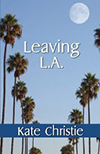
My second novel
Twenty years on, I’ve lived a little more than I had as a newly minted college graduate. Marriage and motherhood, graduate school and multiple careers, and cohabitation with two different partners on both coasts of the country have all exposed me to a wide variety of experiences—and people. Kris is always warning our friends and family to be careful what they say because they might recognize parts of themselves, or at least their words, in my next novel.
And that’s exactly right. I steal from the world around me in order to garnish my fictional worlds with bits of realism. At forty, I hope I’ve collected enough garnish to make for more interesting word salads than the ones I came up with at twenty-one.
Last week Kris and I took Alex to Michigan to vacation briefly with both sides of the family. My mom and I were in the kitchen one night talking about history—personal, political, familial—when she said, “We thought we were changing the world, but we were only changing a decade.”
I smiled and said, “I’m totally going to use that in my novel.”
Sure enough, the latest revision of Family Jewels contains nearly that exact sentence in a bit of dialogue. I’m not too proud to steal from—I mean, to learn from the people who reached middle age before me. Or the ones who’ll come after, either. (That means you, Alex.)
Nor am I too proud, apparently, to wear socks with sandals to my job at the local university. This week, anyway. Next week after all the students return and classes start up again, I’ll probably wear tennis shoes to work.
Now if I can just convince Kris to refrain from commenting on middle-aged women who wear running shoes with dress pants… At least I’m not as bad as this guy, right?
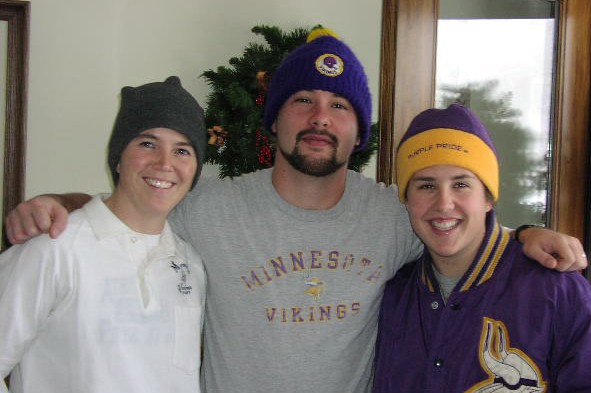
Me, Kris, and Kris’s brother in 2001 before my one and only NFL game in MN
Chris Kluwe, the punter for the Minnesota Vikings, is awesome.
Now, some of you know that it’s difficult for me to say anything nice about a Viking. The daughter of an Illinois man, I am a lifelong Chicago Bears, Cubs, and Bulls fan. As a native Michigander, I also have a soft spot for the Tigers and Lions—though not the Pistons, with their history of dirty play and front-office sexual harassment. This means that I am genetically predisposed to disparage regional rivals like the Packers, Vikings, and Twins. Even more, given that I married into a family of rabid—as in, season tickets on the 50-yard-line—Vikings fans, it takes a lot for me to publicly commend one of “their” players.
Brendon Ayanbadejo, former Bear
But last week, the NFL made news for something other than the commencement of the 2012-13 season when Brendon Ayanbadejo, a linebacker for the hard-hitting Baltimore Ravens, incurred the wrath of a local Maryland politician. Ayanbadejo’s transgression? Voicing his support for gay marriage, which the Maryland legislature recently legalized. The law has yet to take effect, though—opponents of the civil rights law have sponsored a ballot measure that will allow Maryland voters to have the final say this November.
Ayanbadejo, a two-time Pro Bowler for the Bears, has been a longtime supporter of the gay marriage cause, speaking out, writing online pieces, and even offering free NFL tickets for fund-raisers. These off-field activities recently led Maryland House of Delegates member Emmett C. Burns Jr., a Democrat (and, by the way, a Baptist minister), to fire off a letter to Ravens management:
I find it inconceivable that one of your players, Mr. Brendon Ayanbadejo would publicly endorse Same-Sex marriage, specifically as a Raven Football player… I believe Mr. Ayanbadejo should concentrate on football and steer clear of dividing the fan base. I am requesting that you take the necessary action, as a National Football League Owner, to inhibit such expressions from your employees and that he be ordered to cease and desist such injurious actions. I know of no other NFL player who has done what Mr. Ayanbadejo is doing.
As tempted as I am to pick apart this ludicrous attempt by an elected official to suppress the First Amendment rights of one of his constituents, by now Mr. Burns has been adeptly debrided by numerous other writers. One particularly good piece, a Yahoo! Sports article by Dan Wetzel, points out some of the more “inconceivable” aspects of Burns’s attack, including his apparent lack of understanding of the rules of capitalization. Like Wetzel, most analysts have focused on Burns’s attempted abuse of power, and have been supportive of Ayanbadejo’s right to speak out on any issue that moves him. As Ayanbadejo himself tweeted, “Football is just my job it’s not who I am. I am an American before anything. And just like every American I have the right to speak!!!”
Kluwe, wife Isabel, and daughters
So where does Chris Kluwe come in? The Vikings punter, whose brother-in-law is gay, has, like Ayanbadejo, been active in campaigning in support of gay marriage. After the missive from Burns became public, Kluwe penned an open letter to Burns that begins with, “I find it inconceivable that you are an elected official of the United States government. Your vitriolic hatred and bigotry make me ashamed and disgusted to think that you are in any way responsible for shaping policy at any level.”
The letter goes on to critique Burns’s blatant disregard of both the First Amendment and the history of racism in the NFL (Burns is African-American), and closes with a passionate defense of gay marriage in language that even I find somewhat, ahem, colorful:
This is more a personal quibble of mine, but why do you hate freedom? Why do you hate the fact that other people want a chance to live their lives and be happy, even though they may believe in something different from what you believe, or act differently from you? How does gay marriage affect your life in any way, shape, or form? Are you worried that if gay marriage became legal, all of a sudden you’d start thinking about penis? (“Oh shit. Gay marriage just passed. Gotta get me some of that hot dong action!”) Will all your friends suddenly turn gay and refuse to come to your Sunday Ticket grill-outs? (Unlikely. Gay people enjoy watching football, too.)
I can assure you that gay people getting married will have zero effect on your life. They won’t come into your house and steal your children. They won’t magically turn you into a lustful c#$%monster. They won’t even overthrow the government in an orgy of hedonistic debauchery because all of a sudden they have the same legal rights as the other 90 percent of our population, rights like Social Security benefits, childcare tax credits, family and medical leave to take care of loved ones, and COBRA health care for spouses and children. You know what having these rights will make gay Americans? Full-fledged citizens, just like everyone else, with the freedom to pursue happiness and all that that entails. Do the civil-rights struggles of the past 200 years mean absolutely nothing to you?
Well-said, particularly for a straight guy not into “hot dong action,” as he so illustriously puts it. One reason Kluwe’s foray into the battle over gay marriage is particularly noteworthy is that Minnesota, where my wife Kris grew up, has a constitutional amendment coming up on the ballot in November that would define civil marriage as between one man and one woman. I.e., not for we gays.
As Washington residents, Kris and I also have a special interest in the current legal battle over gay rights in Maryland. Our own state legislature recently passed a law granting civil marriage to same-sex couples. This law would require our current home state to finally, officially recognize our 2005 Massachusetts marriage. The only problem is that, just like in Maryland, anti-gay foes here in the Evergreen State have collected enough signatures to force a referendum vote in November.
Given all the recent gains for American gays—the repeal of Don’t Ask Don’t Tell, a Federal Court ruling that California’s Proposition 8 is unconstitutional, the legalization of same-sex marriage in more than a handful of states—it may surprise you to learn that in ballot measures where voters are given the power to legislate our civil rights, we’re 0-for-31.
That’s right, 0 for 31. Our successes in the judicial system and legislative arena (state legislatures, state supreme courts, federal appeals courts, and even the Supreme Court to-date) have made all the difference, while popular votes have, up until now, been the bane of our civil rights.
But that o-fer number is a bit disingenuous, for reasons that the civil rights group Equality Matters does a great job of breaking down:
27 states passed amendments banning gay marriage prior to 2006. Since then, polls show that public support for gay marriage has grown from less than 40% to just over 50%. More importantly, opposition to gay marriage has dropped almost 20% in that same time period.
Anti-gay marriage amendments have had success in states where public sentiment has long aligned against gay marriage. This is the low-hanging-fruit argument—23 of the 29 states where support for gay marriage is weakest have banned same-sex unions. No big surprise, there.
Ballot initiatives, by their very nature, promote misinformation. Equality Matters cites an Oregon Law Review piece from 2008: “Deliberate dissemination of false information can be a particularly potent and harmful strategy to agitate the majority against minority groups. Immune from legislative or executive review, initiative campaigns may rely on appeals to voter prejudice.” The Mormon campaign against gay marriage in California in 2008, for example.
Brendon Ayanbadejo, No Hate Campaign
In both Washington and Maryland, public support for gay marriage has run higher, historically, than in the mostly Southern and Midwestern “low-hanging-fruit” states. In recent polls, voters in both states favor approving their state government’s move to legalize gay marriage. The more public figures and role models who express support for our cause, especially straight guys in uber-masculine professional sports like football, the better the chance we have at winning future popular votes on our civil marriage rights.
So thank you, Brendon and Chris. It takes courage to stand up for a cause that doesn’t affect you personally, yet can put you in peril of losing your job or being targeted by those who disagree—both on and off the field.
This episode appears to demonstrate that just as the country in general has been moving toward acceptance of GLBT citizens, so have many professional athletes (Kobe Bryant aside). I particularly like what Charles Barkley had to say last year on the issue of homosexuality in sports: “First of all, every player has played with gay guys. It bothers me when I hear these reporters and jocks get on TV and say: ‘Oh, no guy can come out in a team sport. These guys would go crazy.’ First of all, quit telling me what I think. I’d rather have a gay guy who can play than a straight guy who can’t play.”
And what does Barkley have to say about gay marriage? “I’ve been a big proponent of gay marriage for a long time, because as a black person, I can’t be in for any form of discrimination at all.”
It’s okay for me to like Barkley, you know. He played in Phoenix, and though his team challenged my Bulls for an NBA title once long ago (1993, my senior year of college), they didn’t stand a chance against Michael Jordan and the rest of the Bulls.
Kind of like the Vikings this year against my Chicago Bears, you know? Sorry, honey, I couldn’t resist…
At least tonight I know my wife and assorted in-laws will join me in cheering for my team as they face off against the hated Green Bay Packers. That’s yet another sports allegiance, I’m happy to report, we share.
Roll Call: Gay or Gay-Friendly American Athletes
Megan Rapinoe*, Soccer, National Team—had to lead with her!
My new novel, Family Jewels, will be out September 28 er, 30 in eBook format, and shortly after that in trade paperback. Family Jewels, another Second Growth Books release, features Elizabeth “Junior” Starreveld, a twenty-something Michigander who is stuck in the middle of the worst year of her life–or so she thinks.
The first three chapters are available in PDF format on my website. To view the official book trailer (in HD), click play below. Enjoy!
I came to Jane Austen late in life. Actually, I came to reading the classics a bit later than most writers probably do. In high school in the ’80s, my experiences with The Literary Canon were nearly always shadowed by a sense of disconnect I can now trace not only to the gender, class, and time period of the characters about whom these assorted novels and plays had been written, but also their sexuality. The world reflected within the literature we studied at Kalamazoo Central High School matched the outer world in a very specific way—everyone appeared to be straight, with barely a hint of same-sex attraction.
As I noted in a previous blogpost, queer characters do, of course, exist in Western literature, just as we have always existed in real, non-literary life. But in most cases, you have to read between the lines quite literally in order to uncover the same-sex attraction alluded to by necessarily closeted writers—Willa Cather and Sarah Orne Jewett, for example. While the act of searching out subcultural cues can be an entertaining pastime, at some point coded invisibility gets old.
My second grade teacher helpfully informed my parents that I was queer, but I didn’t know I wanted to be a writer until the grand age of ten. By the time I started college, I was fed up with studying novels and stories that didn’t reflect my experience…
[To read more on how being a women’s studies major and working at a software company prepared me for the business of self-spublishing, please visit The Henderson Files.]





















 Homodramatica