The other night while I was feeding Alex her before-bedtime bottle, I was suddenly struck by an urge to hear Helen Reddy’s classic “I Am Woman.” So I reached for the laptop sitting nearby on the coffee table, opened a browser window to Google, and searched “helen reddy i am woman youtube.” In 0.15 seconds (roughly), up popped a link to a video of Reddy performing the song live in 1975. When Alex finished her bottle, I burped her, sat her upright, and played the video for her, singing along to the empowering words. Sure, my daughter’s only five and a half months old, but it’s never too early to start teaching her about the strength and power of womankind.
My own parents pioneered this lesson more than thirty years ago when they took my sister and me to our first march on Washington, a NOW-sponsored demonstration to show support for the Equal Rights Amendment (ERA). This hardly radical amendment, first proposed by suffragist Alice Paul’s National Woman’s Party in 1923, was introduced in every Congressional session between 1923 and 1970, but failed to pass Congress until the second wave of the American women’s movement pushed it through.
Here is the text of the ERA, as finally passed by Congress in 1972:
Section 1. Equality of rights under the law shall not be denied or abridged by the United States or by any state on account of sex.
Section 2. The Congress shall have the power to enforce, by appropriate legislation, the provisions of this article.
Section 3. This amendment shall take effect two years after the date of ratification.
After passing the House and Senate as the 27th Amendment of the U.S. Constitution, the ERA was sent to state legislatures for ratification. Like other twentieth-century amendments, the ERA was given a seven-year deadline to achieve ratification by a minimum of 38 states. In the first year alone, 22 states ratified the amendment. But then right-wing opponents of the ERA went to work, drawing on the right’s favorite tool even then—fear tactics, often unfounded, almost always exaggerated.
 In the mid-1970s, anti-ERA advocates like Phyllis Schlafly declared that the amendment was an attack on women and the family. If the ERA were to be ratified, these anti-feminists warned, women could lose their husbands’ financial support and be drafted into the military, while abortion and gay rights would be upheld and states’ rights undermined. In a book called Positive Woman, Schlafly declared, “lesbianism is logically the highest form in the ritual of women’s liberation.” By connecting the ERA with hot-button social issues of the time—Roe v. Wade was decided in 1973, a year into the ratification process—Schlafly and her conservative followers chipped away at support for the amendment particularly in southern states, where opposition to abortion and gay rights has traditionally been stronger than in other parts of the country.
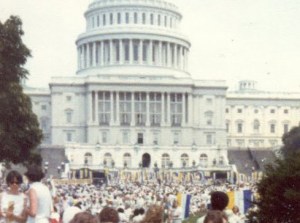
The 1978 ERA Crowd at the Capitol
By the late 1970s, the ERA was in danger of failing to meet its seven-year ratification deadline—only 35 of the required 38 states had voted to ratify. On July 9, 1978, the one-year anniversary of the death of ERA author Alice Paul, NOW organized a pro-ratification march on Washington that drew more than 100,000 ERA supporters from around the country. My mother, a feminist who worked at the time at our local university’s Center for Women’s Services, and my father packed up my sister and me, and we drove from Michigan to D.C. to participate in the March for Equality.
I was only six years old that summer, but I’ll never forget the jubilant mood of the crowd that descended on D.C. I can vividly remember riding on my dad’s shoulders among a sea of smiling people, part of the multitudes of ERA supporters milling about the capitol plaza on that hot July day. The march was marked by the same sense of hope and elation I’ve experienced at almost every peaceful political event I’ve ever attended, along with a palpable air of determination to stand up for women’s rights and the friendliness common among like-minded individuals working for change through the exercise of our First Amendment rights. Talk about an awesome civics lesson.
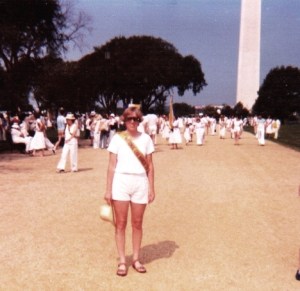
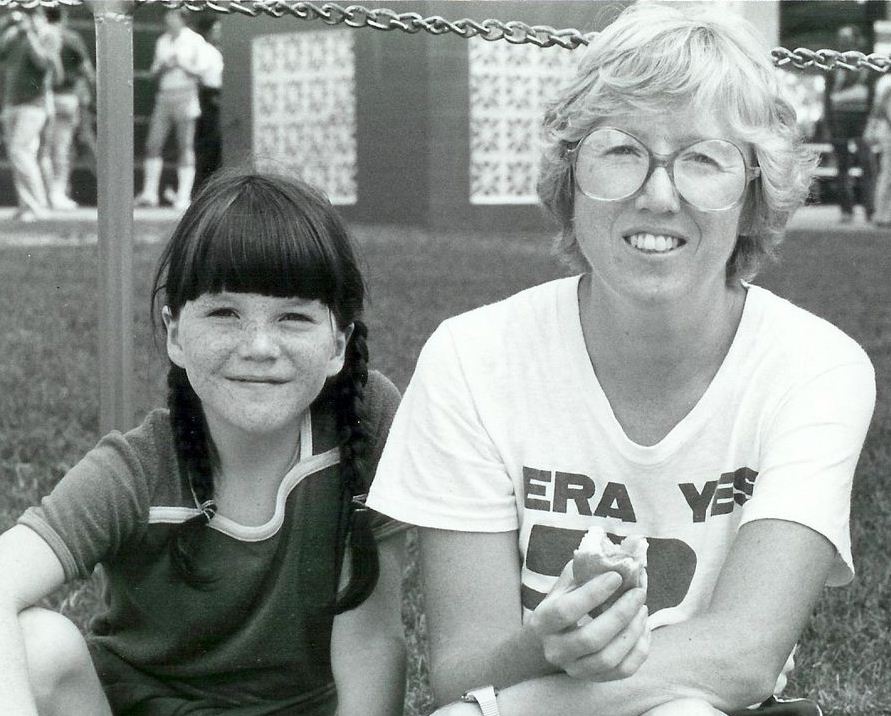
My Mom at the 1978 March for Equality
“It was really miraculous,” my dad says now, looking back across the decades. “At the end of the march, you and I sat down on the grass on a street corner and watched wave after wave of people passing. It was amazing how many people were there.”
My mom had to be back at work on Monday, so way too soon we were climbing into the station wagon and driving through the night to our home in Michigan. My parents, still buoyed by lingering optimism from the weekend, listened to the radio for news of the march, attended by more people than lived in our mid-sized city. To their disappointment, the only news that seemed to be making headlines was a small group of American Nazis who had held a rally in a Chicago park that same day. The rally drew a dozen or so Nazis and a couple of thousand counter-protesters, barely a fraction of the number of ERA supporters who had peacefully marched on the nation’s capital. But the media chose to focus on the Nazi rally while granting the ERA demonstration, the largest feminist political action in American history, only minor coverage.

President Carter Signs the ERA Extension
However, in the wake of the march, Congress passed a joint resolution to extend the deadline to 1982, which President Carter signed in October. This gave ERA advocates three extra years to seek support among the states that had not yet ratified. Unfortunately, as the 1970s came to a close, the American political climate was shifting to the right. In 1980, the Republican Party officially removed support for the ERA from its party platform. Later that year, Ronald Reagan, the first American president to oppose the ERA—even Nixon immediately endorsed it when the bill first passed—was elected.
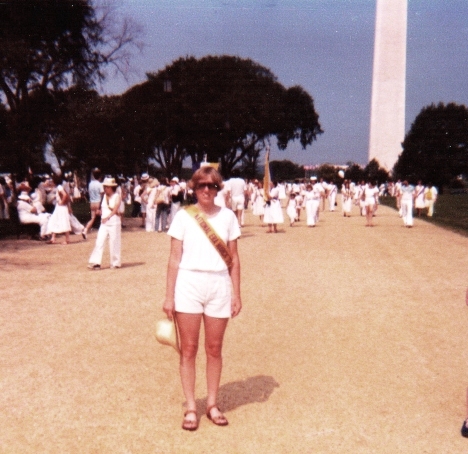
By the summer of 1981, time was again growing short for ratification. To draw attention to the cause, NOW sponsored ERA Countdown Rallies in June in more than 180 American cities. The Washington D.C. rally took place in Lafayette Square near the White House. Road trip veterans, my family again piled into the station wagon and made the long drive from Kalamazoo to Washington to lend our voices and bodies to the cause. The crowd’s mood this time wasn’t quite as jubilant, tinged even with a sense of uneasiness. The window of opportunity seemed to be closing on the ERA, and who knew when it might open again?

Me and Mom in D.C., 1981
Despite the marches and rallies, hunger strikes and peaceful sit-ins, petitions and acts of civil disobedience, the heady activist days of the sixties and seventies were over. No additional states ratified the ERA after 1977, and the 1982 deadline came and went without being met. The Equal Rights Amendment, passed by Congress a decade earlier, had failed to achieve ratification.
In the decades since, the ERA has been reintroduced in each session of Congress, but as in earlier decades, it has been mainly held in committee. In 1983, the only other year Congress actually voted on the amendment, 14 cosponsors of the bill voted NO, while 3 failed to vote at all. The ERA was defeated that year by a measly six votes.
Since the early ’90s, ERA activists have adopted a new approach deemed the “three-state strategy,” taking cues from the most recently ratified constitutional amendment. Had it been approved, the ERA would have become the 27th Amendment to the U.S. Constitution. Instead, the “Madison Amendment,” which mandates when Congressional salary changes may go into effect, became the 27th Amendment when state #38 ratified it in 1992—despite the fact that the Madison Amendment had been passed by Congress in 1789, more than 200 years earlier.
The ERA’s case is a bit more complicated given that Congress stipulated a 7-year deadline for ratification in the bill’s proposal, with an additional 3-year extension added later. But pro-ERA legal analysts maintain that based on the two centuries granted to the Madison Amendment, the ERA’s pre-1982 ratification tally of 35 states should be allowed to stand, in which case only 3 more states would be required to ratify the amendment now. The Congressional Research Service analyzed this argument in 1996, and agreed that the three-state strategy may in fact have merit.
What would be required for this strategy to succeed? Congressional support like we saw in the early 1970s. A pro-ERA President wouldn’t hurt matters, either.
 The fact that our government has refused for nearly a century to pass an amendment that guarantees equal treatment of American women under the law is a sign we still have a lot of work to do, in my opinion. Apparently other people agree—since I started writing this blog post a few days ago, the Huffington Post’s Barbara Hannah Grufferman penned an article, “What It Means to Be 50 and a Woman in America in 2011: A Birthday Message to President Obama,” in which she challenges President Obama to lead the fight for the ERA to become the 28th Amendment to the U.S. Constitution. The President should fight for the ERA, she argues, “to ensure the legal and constitutional rights of women in America, including those of his daughters.”
What rights are those? Here are just a few:
- The right to be paid the same as men for equal work. American women still make just 77 cents to every dollar a man earns for equal work.
- The right to help lead our government and the corporations where we work. Women in leadership positions in America, both in business and politics, are still few and far between.

- The right to affordable childcare. According to a recent study published by the National Association of Child Care Resource and Referral Agencies, child care fees in the United States exceed annual food costs and median monthly rent and mortgage payments.
- The right to choose how to manage our reproductive systems. Since 1973, anti-choice activists have worked to pass legislation limiting access to abortion among girls and low-income women, while fundamentalist organizations have set their sights on Planned Parenthood who, by the way, spends only 3% of its total health care services budget on abortion.
- The right to be free of fear, both from strangers and from spouses/ partners. According to the National Violence Against Women Survey, 17.6 percent of women respondents had been raped at some point in their lifetime, while national statistics reveal that 40 to 50% of the several thousand American women murdered each year are killed by an intimate partner.

As the daughter of feminists, I was taught from an early age to champion the fight for women’s equality. As a Women’s Studies major at Smith College, I studied the history of the first and second waves of the U.S. women’s movement, and learned how to advocate for women’s rights in a patriarchal culture. As the new mother of a daughter, I now have a slightly altered perspective—it isn’t just me or my mother or my sister or my wife whose rights are at stake. It’s my daughter, too.
Two and a half years ago, President Obama shared a letter with PARADE that he wrote to his daughters on the occasion of his inauguration. In it, he said:
America is great not because it is perfect but because it can always be made better—and… the unfinished work of perfecting our union falls to each of us. It’s a charge we pass on to our children, coming closer with each new generation to what we know America should be….
These are the things I want for you—to grow up in a world with no limits on your dreams and no achievements beyond your reach, and to grow into compassionate, committed women who will help build that world.
Here, here! To our President’s words I add the following: I am a woman, and a feminist, and a lesbian, and a mother. And, naturally, I am still roaring.

Yes we can!





























 Homodramatica